

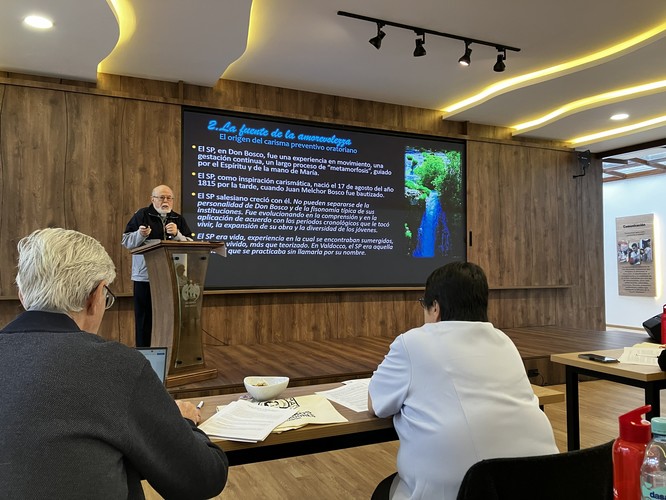
presentation during his talk.
Credit: Fr. John Puntino, SDB
By Fr. John Puntino, SDB Delegate, Salesian Cooperators (Canada)
On Friday, October 2, Fr. Luis Timossi, SDB, from Centro Salesiano de Formación Permanente América (CSFPA), gave a major presentation on the Preventive System at the Interamerica Salesian Family provincial delegates meeting in Quito, Ecuador.
The 150th anniversary of Don Bosco’s booklet on the Preventive System, along with the Rector Major’s 2027 Strenna and the challenges of meeting the needs of today’s world, motivated his research. He stated his task as: “To acquire a renewed understanding and a fruitful assimilation of the Preventive System, harmonizing fidelity to Don Bosco’s charismatic insights with a creative and discerning adaptation to the challenges of emerging cultures, inviting us to embark on concrete paths of unity and renewal within the Salesian Family in the Americas.”
1.) Under the same digital sky: The challenges of a globalized reality
Vatican II in Gaudium et Spes (1965), the Aparecida document (2007), Pope Francis repeatedly, and Pope Leo XIV point to a rapidly and profoundly changing world. The challenge of this era of change, this globalized, digitized world is for the Church, under the guidance of the Holy Spirit, “to begin a shared discernment process for identifying the spiritual and cultural roots of ongoing transformations” (Magnifica Humanitas, 6).
2.) The source of amorevolezza (loving-kindness): The origin of the Oratory’s preventive charism
The Preventive System is Don Bosco’s lifelong experience, beginning with his baptismal gift on August 17, 1815, of the Holy Spirit and Mary. It grew with him as he gradually understood it and adapted it to changing circumstances. As Fr. Pietro Braido writes, “the best interpreter of Don Bosco, whom both theorizes and writes, is Don Bosco himself. He creates and shapes his educational experience and embodies it in his works, together with the educators and the young people” (Prevenire non reprimere, p. 145).
3.) Cracks in the courtyard: Difficulties in living out and embodying the Preventive System
Don Bosco acknowledged that it is difficult to live the Preventive System. As the Congregation expanded, it became increasingly necessary “to distinguish between what was essential and what was contingent in the educational style, and to identify how much of it could be transferred to other settings” (Fr. Timossi). The Letter of 1884 and letters to the missionaries Bishop John Cagliero, Fr. James Costamagna and Fr. Dominic Tomatis point to Don Bosco’s call to return to “the days of affection,” “charity, patience, gentleness,” “gentleness in speaking, in acting and in giving advice.”
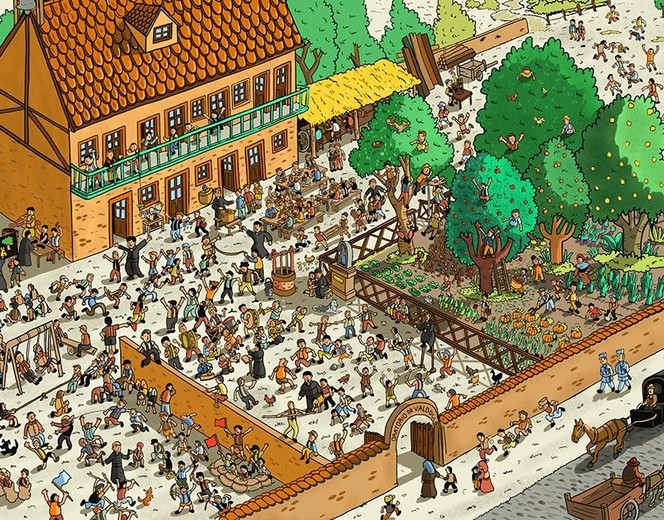
Credit: Verónica Mariño
4.) As Time Went On: ‘Preventive System’ — first formulation
Don Bosco’s booklet on the Preventive System began as a speech on March 12, 1877, during the inauguration of the Patronage of St. Peter in Nice. Written and rewritten over three days, it was published for the people of France to know the work of the Salesians. It is Don Bosco’s mature, clear, and most complete description of his system of education and evangelization. It has become the classic expression of Salesian work for young people. Other works, such as “The Preventive System Applied to Young People at Risk” (1878), built on the booklet.
Fr. Braido suggests that “when Don Bosco wrote The Preventive System, he may have had in mind not only his own personal experience, but also that of his collaborators, who were as immersed as he was — and even more so — in the myriad contingencies of life within an educational world that was extremely dynamic and full of surprises” (Prevenire non reprimere, p. 173).
5.) The boundaries of the first map: Validity and limits of the first formulation of the Preventive System
While the booklet captures in some ways, the concepts of Don Bosco’s lived experience it runs the risk of “fossilizing” the experience. “Don Bosco himself seems to be aware of this limitation and ‘warns’ the reader, stating that this text is merely ‘the table of contents of a little work’ which he would ultimately never write” (Fr. Tomassi). Scholars point out some of the limitations of the work. It uses a reductive statement in comparing the preventive and repressive systems; the emphasis on prevention defines the system using a negative term, it focuses on schools and omits the vocational training element of Salesian works, and it overemphasizes “visual” assistance over “loving” spiritual assistance, as seen in Don Bosco’s relationships with Dominic Savio and Michael Magone.
Fr. Pietro Stella claims that “Don Bosco did not consider himself rigidly bound by the formulas of his Preventive System” (Don Bosco in the history of Catholic religiosity, p. 463). For example, in his later years, he preferred to use terms such as gentleness, meekness, charity, and patience rather than amorevolezza.
6.) A new city beside the old fountain: The need for a ‘new’ Preventive System
The booklet shows how Don Bosco took his charismatic inspiration and adapted it to his historical reality. Fidelity to Don Bosco means having, as Fr. Egidio Viganò expressed it, a “new Preventive System” for the “new evangelization.” He then invites the Salesian Family to read St. John Paul II’s letter, Iuvenum Patris (on Strenna 1995). Fr. Braido envisions “a Preventive System put into practice using a variety of preventive methods” (Prevenire, non reprimere, p. 146).
7.) Watermarks in the 1877 pamphlet: A reflective reading of the text on the Preventive System
Fr. Timossi happily uses the image of a watermark in identifying 10 key points of Don Bosco’s charism that emerge from the text of the booklet.
- The text reflects Don Bosco’s experience; it is the fruit of his pedagogical and spiritual wisdom.
- The heart of preventative education is the bond of warm friendship that focuses on the learner as a person.
- With the optimistic humanism of St. Francis de Sales, Don Bosco believed in the inherent goodness of human beings and so promoted “freedom wrapped in charity” that stimulates shared responsibility.
- The Preventive System rests entirely on charity, the love of God embracing all human beings.
- Education is a matter of the heart. “Education takes place between the heart of the young person and the heart of the educator, passing through the heart of God” (Fr. Timossi).
- The sacramental life of the educator and pupil is the lifeline from the Sacred Heart of our Lord for the educational relationship.
- The total dedication of the educator forms the foundation of his authority and guarantees the morality of the house.
- The three pillars of reason, religion, and loving-kindness are three facets of God’s love becoming “a light for the intellect,” “an experience of the beauty, grandeur and sublimity of Religion” and “love in action.”
- Don Bosco insists on the art of not punishing and consistently exercises it.
- To form “useful citizens and good Christians” means forming young people to contribute to the good of family life, society and the Church.
8.) Winged Roots: Guidelines for safeguarding and implementing the Preventive System
And so Fr. Timossi offers nine criteria for engaging “our globalized reality” with insights from the booklet on the Preventive System.
✨ As admirers and scholars of Don Bosco’s personality, our model is to form an affectionate bond of sonship with him, become a disciple of him, the teacher and educator, connect in and through him with God, who guides us, and unite in harmony with his smile, experiential joy, and affability, “happy to dwell in his courtyard.”
✨ “Through the eyes of Don Bosco”: to look at young people with love, through God’s eyes.
✨ With one ear attuned to the Spirit and the other to young people: to remain faithful both to the changing reality of young people and to the Holy Spirit, with the hallmark of predilection for young people, to unite the love of God and the love of young people in a single act of charity.
✨ In continuous shared formation: on the 150th anniversary, to form ourselves in the way of the charism of the Preventive System and apply it in new ways of acting.
✨ From a spiritual and educational perspective: to work with and through young people for their salvation, as Don Bosco did.
✨In communion and synodality: to recognize that we, the SDB community, the Educational-Pastoral Community, and the Salesian Family are Don Bosco today and the Preventive System today.
✨ Articulating and reinterpreting the four Oratory dimensions: to respond to young people’s afflictions of loneliness, lack of meaning in life, lack of access to education and work, and the loss of joy and freedom by implementing the Oratory criteria in all Salesian works.
✨ Fostering processes: to respond to the intrinsic mobility of today’s globalized culture by “prioritizing actions that generate new dynamics” (Pope Francis).
✨ With humour, joy, and a smile on our faces: to be the Salesian, the smiling Don Bosco of today, winning hearts with “the madness of mutual love.”
Read Fr. Timossi's full presentation in English, French, and Spanish.
Latest Posts

Province Celebrates Its 2026 Jubilarians
Fr. Tim Ploch took to the podium to honor his fellow jubilarians. Read more

Journey to Turin for Next Year’s Salesian Family Spirituality Days
Submit your nominations as soon as possible! Read more

Directors’ Meeting and Formation Day
The theme of global unity and diversity was also discussed during the jubilees celebration. Read more

- 1 of 820
- ›
Categories
Archive
- October 2026 (23)
- September 2026 (20)
- August 2026 (16)
- July 2026 (14)
- June 2026 (11)
- May 2026 (25)
- April 2026 (19)
- March 2026 (26)
- February 2026 (17)
- January 2026 (24)
- December 2025 (23)
- November 2025 (12)
- October 2025 (28)
- September 2025 (18)
- August 2025 (21)
- July 2025 (14)
- June 2025 (19)
- May 2025 (19)
- April 2025 (29)
- March 2025 (25)
- February 2025 (22)
- January 2025 (21)
- December 2024 (23)
- November 2024 (19)
- October 2024 (30)
- September 2024 (19)
- August 2024 (23)
- July 2024 (19)
- June 2024 (16)
- May 2024 (26)