

By Fr. Sebastian Koladiyil, SDB, Editor, Salesian Bulletin of East Africa
This is the inspiring story of a Salesian priest, Fr. Edward Liptak, whose vocation was shaped by faith, family, and God’s providence. From his humble childhood in a Slovak immigrant family in New Jersey to more than six decades of priestly ministry, including many years of missionary service and formation work in East Africa, he reflects on the people, experiences, and moments that guided his journey. His story is a testament to faithful service, lifelong dedication, and the conviction that, with God, nothing is coincidental.
[U.S. editor’s note: Fr. Ed belonged to the SUE Province until he joined Project Africa. He served at Don Bosco Juniorate in Paterson, Archbishop Shaw High School, and as director of St. Dominic Savio High School in East Boston and Don Bosco College in Newton. When he returned from Africa to the U.S., he asked to go to California because his brother Bill lives there and his parents are buried there. Thus he’s now part of the San Francisco Province, continuing his priestly ministry at Corpus Christi Parish in San Francisco and writing Scripture reflections regularly for InTouch, the Western Province’s newsletter.]
Describe your early childhood life
My parents emigrated from Slovakia. My father worked as a bread salesman, and I often accompanied him. My mother shared his humble values. Our family included four boys; three of us helped my father, while the fourth served in the military during World War II and, thankfully, returned safely. At the time, we lived in a house that was still under construction; my dad was the chief builder.
All four of my grandparents came from the eastern part of Slovakia, now the Slovak Republic. Although we were of Slovak background, I attended Holy Trinity Parish in Passaic, N.J., which was of German origin. Passaic had several national parishes, serving Slovak, Italian, Polish, and Hungarian communities. We belonged to St. Mary’s Parish, well known for its large and active Holy Name Society.
How did your journey to the vocation of priesthood begin?
I was born to first-generation Americans, and my father ensured we grew up as Americans. From Passaic, we moved to Montague, N.J., about 20 miles from Newton, a center of the Salesians of Don Bosco and also home to a Benedictine missionary congregation. Since our parish, St. James the Greater, was part of the mission area in northern New Jersey, Benedictines often came to celebrate Mass, as did Salesians from Don Bosco College.
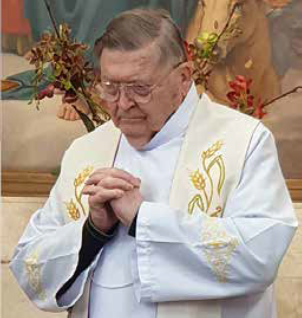
Credit: Salesian Bulletin of East Africa
It was there that I became close to our parish priest, Fr. John Euston, who inspired my admiration for the priesthood. My father’s sister Bertha often encouraged me to become a priest. I still remember one day at our kitchen table when she asked again, “Eddie, why don’t you become a priest?” Frustrated, I slammed the cabinet door and replied, “I am not going to become a priest!” Middle Europeans are known to be stubborn. At the time, I was a very stubborn 16-year-old.
One of the Salesian priests, Fr. Felix Penna, regularly visited our family. His lively and friendly personality impressed me, while the Benedictine missionary who visited was much quieter. When the time came to make a decision, I sought advice from Fr. Euston. He simply said, “Go to Newton, make a retreat, and think about becoming a priest.”
Our mission church was the northernmost church in New Jersey, and our new pastor, Fr. Francis Warlokowski, also advised me to make a retreat. That summer, I attended a retreat at Don Bosco College in Newton.
What was your decision after the retreat?
After the retreat, I became certain that if I became anything, it would be a priest who was also a teacher. For me, that meant becoming a Salesian of Don Bosco.
When I shared my decision with my father, he encouraged me with words I have never forgotten: “The Benedictines have a great past, but the Salesians have a great future.” Those words, spoken around 1948, strengthened my resolve. I suppose I inherited some of my father’s ambition. He sold bread, and eventually I also became a salesman, but instead of bread, I came to “sell” what I call the “Wonder Bread,” the Holy Eucharist, even to this day.
Describe your journey into the Salesian Congregation.
Joining the Salesians came naturally after the retreat. At the end of it, I made my confession to Fr. Joseph Caselli, a respected Salesian from the Eastern Province of the United States. When I asked him, “Do you think I can become a priest?” he simply replied, “Why not?”
Back home, my father repeated his conviction: “Go to the Salesians, because the Salesians have a future. The older orders have a great past, but the Salesians have a great future.” My mother was delighted because she had always prayed that one of her sons would become a priest, and it turned out to be me. Today, well past my ninetieth birthday when I first entered, and after more than sixty-seven years of priesthood, I serve at Corpus Christi Parish in San Francisco. For a while I was pleased to serve alongside Fr. Al Pestun, who died in 2022. We were ordained together on June 13, 1959, at Mary Help of Christians Church in Watsonville, Calif., after completing our theological studies in Aptos, Calif.
We continued our priestly journey together till his death.
“Go to the Salesians; they have a great future.”
Tell us about your formation.
My aspirantate took place during my fourth year of high school in West Haverstraw, N.Y., at a Salesian center that remains a pilgrimage site dedicated to Mary Help of Christians. Its magnificent statue overlooking the Hudson River Valley continues to inspire devotion and peace.
After one year in West Haverstraw, N.Y., I moved to Newton, NJ, where I studied more Latin before entering the novitiate there; it was close enough for my parents to visit regularly. I later completed my philosophy studies in the same community. Many people in the U.S. Western Province know my parents because, when I was a theology student in California, my mom became our cook, and my father was the caretaker.
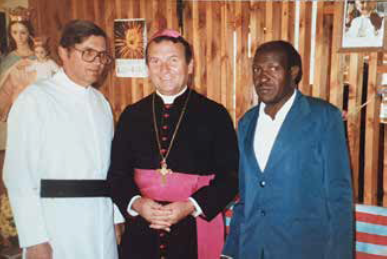
Credit: Salesian Bulletin of East Africa
“From selling bread to sharing the ‘Wonder Bread’ of the Holy Eucharist.”
How was this transition period for your family?
My connection with the Salesians began shortly after the Second World War. I remember my elder brother returning safely from military service, while my father, who knew the Church well and enjoyed defending it, strongly encouraged my vocation.
My younger brothers, Bill and Jim, were twins. Sadly, Jim died of leukemia at age fourteen. His death deeply affected our family. My father blamed himself, believing he had not practiced well enough the faith he knew so well. Jim had always wanted to become a priest, while I had once “slammed the door” on the very idea. I remembered that moment as I stood beside his deathbed.
Bill, the surviving twin, still feels the loss deeply. Today he is well known at Mary Help of Christians Parish in Watsonville, where his older brother (me) was ordained and where he faithfully serves the parish community.
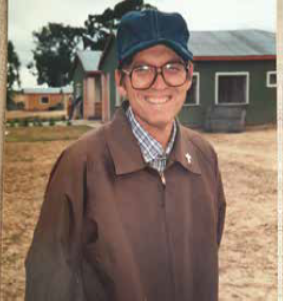
Credit: Salesian Bulletin of East Africa
How were your theology days?
I studied theology in Aptos, along Monterey Bay, for four years under outstanding teachers. One was an immigrant priest from Yugoslavia who had fled the war, and another was Fr. Arthur Lenti, renowned for his teachings on Don Bosco and Scripture. As the Church embraced a renewed focus on Sacred Scripture, I benefited greatly from their guidance. Even today, I continue leading weekly Bible study every Tuesday evening.
During those years, I met Fr. Al Pestun, with whom I was ordained and with whom I served later at Corpus Christi. Although we did not receive formal academic degrees, we were given excellent formation and strong pastoral training. I remain deeply grateful for those years and the foundation they provided.
How long have you served as a priest in this region, and where else have you worked?
After ordination, I was assigned to formation work within Salesian communities. I first served at a Salesian high school and later at Don Bosco Technical High School in Paterson, N.J., where brother candidates were being formed. Later, I was assigned to Don Bosco College in Newton, N.J., where I worked with philosophy students and served as director for six years before leaving for the African mission.
In East Africa, I served in several formation roles. I was first assigned to Mafinga, Tanzania, where I helped establish the junior seminary while serving in parish outstations. Later, I became novice master in Moshi, then director of theology students in Karen-Nairobi. I also helped establish the postnovitiate formation program for Salesian brothers.
How did your vocation to the African mission come about?
My vocation to the African mission began while I was serving as director at Don Bosco College in Newton and was elected to attend the 21st General Chapter (1977-1978), which marked the beginning of Salesian work in East Africa.
At the end of the chapter, we were reminded of Pope Paul VI’s appeal after his visit to Uganda, encouraging missionary congregations to foster vocations in Africa. The chapter approved “Project Africa,” and, nearing the end of my six-year term in Newton, I volunteered for the East African mission. I requested an English-speaking country and formation work. Although I was initially assigned to Nairobi, I was first sent to Mafinga, Tanzania, before eventually moving to Nairobi in 1989.
Tell me more
Looking back, my great-grandfather Liptak helped build Our Lady of the Assumption Church in New Jersey.
My parents were married there, many of my family members were buried there, and my younger brother married there shortly before his daughter Laura was born on the feast of the Assumption.
These events strengthened my conviction that Our Lady of the Assumption had guided my missionary vocation, especially since I left for Africa on the feast of the Assumption.
After a short stay in Rome, I traveled to Dar es Salaam and then to Mafinga, where I learned Kiswahili.
Fr. Peter Matthew, a Salesian missionary from India, sent me to a former parish center at Makalala. While celebrating Mass there, I noticed both an image and a statue of Our Lady of the Assumption. When I later asked Fr. Peter about them, he smiled and said, “Didn’t you know? This is Our Lady of the Assumption Parish.”
I often say — and truly believe — that with God, there are no coincidences.
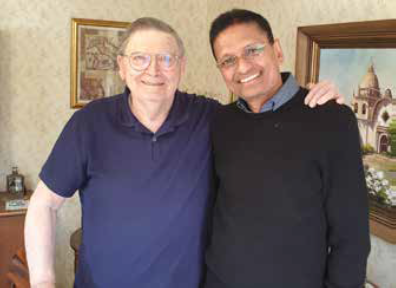
Credit: Salesian Bulletin of East Africa
"With God, there are no coincidences, only providence."
How long did you serve in the African mission, and what roles did you hold?
I spent my first seven years in Tanzania helping establish the junior seminary while serving the parish outstations. My missionary vocation allowed me to dedicate myself to formation throughout my ministry.
I am grateful to have served in every stage of Salesian formation. I was involved in the junior seminary at Mafinga, philosophy in Newton, novice formation in Moshi, theology formation in Nairobi and Karen, and later established the additional years of formation for Salesian brothers. Earlier in my priesthood, I had also served as a catechist for Salesian brothers in Paterson, N.J. Pardon me for being boastful, as even St. Paul allowed himself such a moment. Looking back at the age of ninety-six, I remain deeply grateful to have been entrusted with every stage of formation within the Salesians of Don Bosco.
Latest Posts

Etobicoke: “The Spirit of Joy” Captures Salesian Mission in Action
Don Bosco had a dream — and the dream goes on. Read more

Marrero: Archbishop Checchio Visits Shaw
After Mass, Archbishop Checchio blessed the site of the new Student Commons Building. Read more

Port Chester: Young Adults Host Spanish Retreat
The theme was based on 1 Cor. 3:16: “You are temples of the Spirit.” Read more

Categories
Archive
- April 2024 (27)
- March 2024 (27)
- February 2024 (25)
- January 2024 (18)
- December 2023 (13)
- November 2023 (27)
- October 2023 (16)
- September 2023 (19)
- August 2023 (22)
- July 2023 (25)
- June 2023 (31)
- May 2023 (35)
- April 2023 (25)
- March 2023 (42)
- February 2023 (32)
- January 2023 (33)
- December 2022 (26)
- November 2022 (20)
- October 2022 (34)
- September 2022 (28)
- August 2022 (31)
- July 2022 (26)
- June 2022 (31)
- May 2022 (29)
- April 2022 (22)
- March 2022 (34)
- February 2022 (32)
- January 2022 (31)
- December 2021 (24)
- November 2021 (30)