

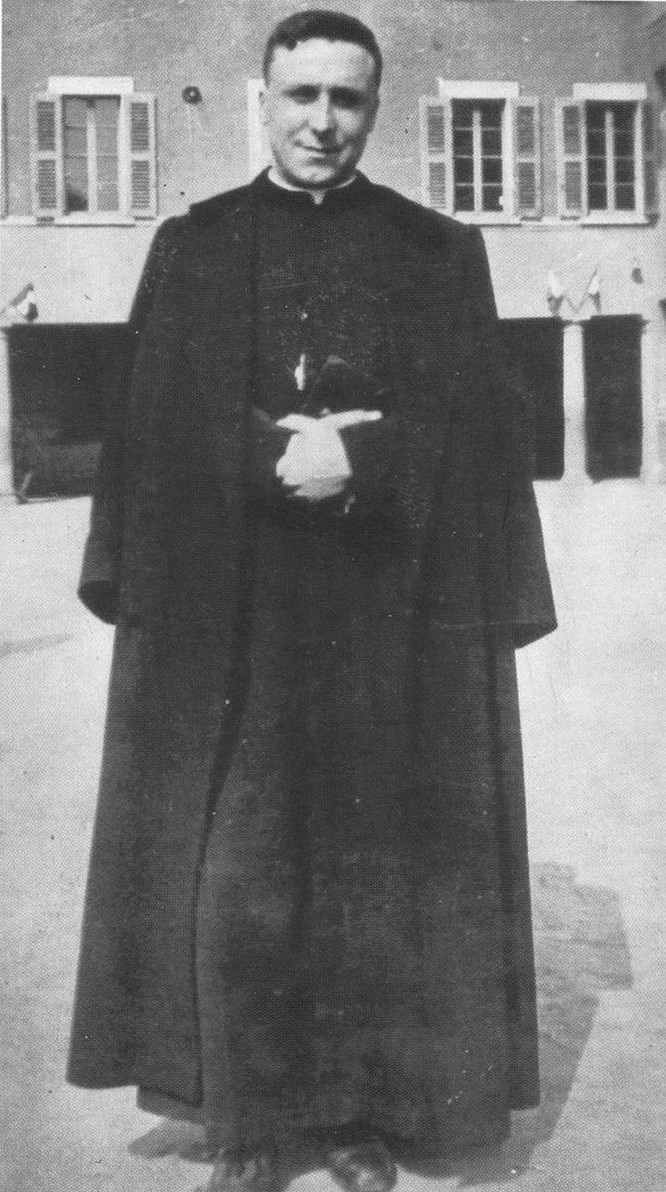
Credit: Agenzia Info Salesiana (ANS)
By Fr. Mike Mendl, SDB
Elijah’s Vocation
Just before his priestly ordination, Salesian Elijah Comini drew up a rule of life for himself based on a “constant pursuit of holiness and perfection. To nourish his drive toward his own sanctification, he committed himself to meditating frequently on his own insignificance in the face of the infinite grace of the priesthood. The regulations identify three key virtues to be practiced consistently and sought for daily in prayer: humility, purity, and charity.” (ANS 9-16-26)
Charity, in particular, led him to become a witness to the love of Christ for his flock, even to laying down his life.
Elijah (Elia in Italian) Comini was born in Calvenzano di Vergato (province of Bologna) on May 7, 1910, the second son of Claudio and Emma Limoni Comini. The family soon moved nearby to the town of Salvaro. Claudio died while Elijah was young.
As a youth doing military service, Salvaro’s pastor Msgr. Fidenzio Mellini had frequented the Oratory in Turin and was acquainted with Don Bosco. He was happy to guide 14-year-old Elijah to the Salesian aspirantate at Finale Emilia. At 15 Elijah entered the novitiate, October 1, 1925, and he made his first profession on October 3, 1926, as a member of the Lombardy-Emilia Salesian Province. He studied philosophy at Valsalice and did practical training at Finale Emilia, Sondrio, and Chiari. He professed perpetually on May 8, 1931.
Fr. Elijah’s Spiritual Life
A diary that Bro. Elijah began at Valsalice, specifically on Dec. 31, 1927, and kept until just before his death — the last entry is for July 22, 1944 — reveals a deep interior life. For instance, before renewing his vows, he wrote: “I’m happier than ever today, the vigil of the self-offering I hope will please You. Accept me as an expiatory victim, even though I don’t deserve it. If You wish, give me some recompense: pardon the sins of my past life; help me become a saint.” At the time of his ordination, he prayed for a “heroic love for souls.”
Fr. Elijah was ordained at Chiari (province of Brescia) on March 16, 1935, and assigned to Salesian schools in Chiari (1935-1941) and Treviglio (province of Bergamo, 1941-1944). In 1939 he completed a doctorate in classical literature at the University of Milan. He was an excellent teacher of humanities and a trusted confidant for many young people. One confrere remarked, “They seemed like a brood of chicks around the hen.” His director at Treviglio observed: “His constant calm was admirable; I never saw him lose his patience in dealing with youngsters, but he obtained good discipline easily. He didn’t seek popularity but was always modest and humble.”
During the summer, with his superiors’ approval, Fr. Elijah would return to Salvaro to assist his widowed mother and help Msgr. Mellini in his pastoral work.
In the Context of War
After Italy surrendered to the Allies and Mussolini’s regime was overthrown in September 1943, the German army occupied most of Italy and fought not only the Allied forces moving northward up the peninsula but also Italian partisans on all sides. Where the partisans were active, life was precarious for Italian civilians in both city and countryside.
In June 1944, 34-year-old Fr. Elijah and Fr. Martin Capelli, 32, a priest of the Congregation of the Sacred Heart (Dehonians), both went to Salvaro.
In August, a battalion of the notorious S.S. took over the rectory for a month and tried to deal with the advancing Allies as well as partisans.
The two priests continued to celebrate the sacraments, preach, teach catechism and music, visit the sick, conduct funerals, care for the religious sisters, and try to comfort those who were threatened by the Germans.
They also tried to mediate among opposing sides: the local population, partisans, and the German army. Nevertheless, after a skirmish with their enemies, on September 29 in nearby Creda, the Germans massacred about 70 civilians in reprisal, including women and children.
Martyrdom
Fr. Elijah’s rule of life from 1935 maintained that all his work had to be carried out “in the shadow of Jesus” and for his most lovable Heart. This total Christ-centered orientation was reflected in an outward composure and seriousness befitting one who lives united to the Lord; summarizing his commitment with the invocation: “Everything, always for the Sacred Heart and in the Sacred Heart.”
Thus it was that Frs. Elijah and Martin rushed to the scene of the Creda massacre with stoles, holy oils, and the Eucharist to try to assist others being held by the S.S., as well as the dying. But the Germans seized them, stripped off their vestments and sacred vessels, and put them to labor “like beasts” carrying ammunition. The two priests suffered an intense passion that day, forced to witness the “most gruesome violence.” Brought to the “house of the cart drivers” in Pioppe di Salvaro by night, they spent two intense days, convinced from the beginning that they were going to die, all the while remaining close to the prisoners, always ready to comfort, help, and absolve.
One prominent citizen, claiming to be Salvaro’s mayor — he was lying —interceded with the S.S. commander for the release of the priests. Fr. Elijah refused unless all the captives were let go. His words, “Either all of us or none,” are inscribed on a monument to the two martyrs later erected in Salvaro (see photo). The prisoners were comforted by the presence of the priests with them.
On the evening of October 1, 1944, 52 prisoners were lined up along a culvert near a hemp field’s water tank, dry and muddy at the time, that led to the Reno River. Fr. Elijah, carrying his breviary, to which he was most devoted, intoned the Litany of Loreto, thus transforming the scene into a procession toward Heaven. A German officer violently struck Fr. Elijah’s hands, and his breviary fell into the muck. Finally, Fr. Elijah shouted, “Have mercy, O Lord!” as the soldiers machine-gunned the 52.
In those moments, Fr. Elijah’s body shielded Pio Borgia, one of only three survivors of the massacre and a key witness to the events.
The bodies were piled up in the mud of the water tank. In the following days, due to the torrential rains, the spillway was opened and the wild current of the Reno carried away the corpses.
What the Nazis did in that area became known as the massacre of Marzabotto or the massacre of Monte Sole. It occurred in 115 locations; the combined Nazi and Fascist forces killed 955 men, women, and children, including three priests who were exercising their ministry.
Heroic Recognition
At Salvaro in September 1977, Bishop Benito Cocchi said: “The martyrdom of priests is the result of their conscious choice to share the fate of the flock to the point of extreme sacrifice, after the efforts of mediation between the population and the occupiers, long pursued, have lost all chance of success.”
With the Church’s recognition of the priests’ martyrdom “in hatred of the faith,” Fr. Pierluigi Cameroni, Salesian postulator general, stated: “The profound source of the pastoral style of the Servant of God Elijah Comini lies in his choice to lay down his life for his brothers, as Jesus did when He gave Himself over to death for all sinners. Throughout his life and until the very end, he strove to be a good shepherd, giving himself without reservation and with generous self-sacrifice in a one-way exodus from himself. This is the true essence of his pastoral charity, showing him as a model shepherd who watches over his flock, defending the weak and the innocent.”
The beatification rites were celebrated in the cathedral of Bologna, led by Cardinal Marcello Semeraro, prefect of the Congregation for the Causes of Saints, representing Pope Leo XIV.
An exhibition in Bologna in these days notes that these were “priests who chose not to flee. They became ‘Cyrenians,’ sharing the burden of the cross, humiliated as ‘beasts of burden,’ and executed alongside their brothers and sisters. Yet, right up to their last breath, they were able to implore mercy, blessing, and forgiveness.”
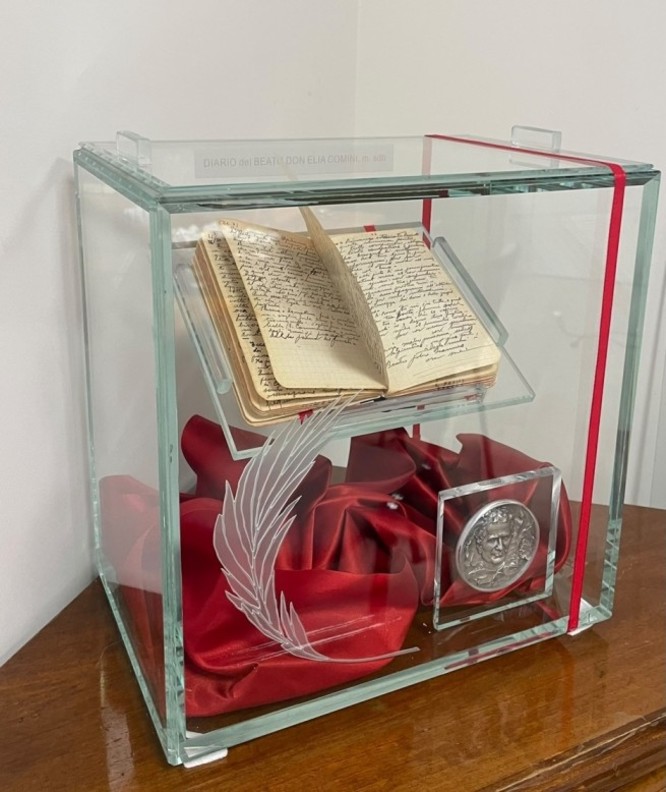
This was made because his body could not be
recovered after his murder.
Credit: Agenzia Info Salesiana
Since Fr. Elijah’s body couldn’t be recovered after his murder, a reliquary containing his spiritual diary has been made (see photo). The diary is a small notebook filled, page after page, with close, minute handwriting. In the glass case are etched a palm, symbolizing martyrdom, and the Salesian coat of arms. Within it are a medallion with the image of Don Bosco and a red cloth, suggestive of a handkerchief — for Don Bosco a symbol of obedience, readiness to be completely at the disposal of ministry for souls, and red for blood shed.
Two Others Beatified with Fr. Elijah
Fr. Elijah’s immediate companion in ministry and martyrdom was Fr. Martin Capelli, SCJ. Ordained in 1938, he was a seminary professor. In the summer of 1944, he came to Salvaro to help in the pastoral care of the village, despite the area’s being a center of armed clashes involving German and Allied soldiers and partisan groups. After the massacre perpetrated by the S.S. in the nearby locality Creda, he joined Fr. Elijah in rushing to comfort the dying and was seized, abused, and executed.
A third priest was beatified with the two martyrs of Monte Sole. Fr. Ubald Marchioni was an exemplary priest of the Bologna archdiocese, faithful to his community even in the most tragic moments of World War II. Ordained in 1942, he became pastor in San Martino di Caprara and Casaglia beginning in May 1944 while the Germans were trying to deal with the local partisans. On September 29, with the people terrified by the S.S. presence, he went to the church in Casaglia to safeguard the Blessed Sacrament and to offer refuge to a small crowd of frightened people. He urged the men to hide in the woods, keeping only women and children inside the church, but negotiations with the S.S. to let them go failed: all were taken to the cemetery and killed. Fr. Ubald was left at the church and shot in the head in front of the altar.
Latest Posts


Stony Point: One Busy Weekend, Many Blessings
It was another very busy weekend at the National Shrine! Read more

Port Chester: St. John Bosco Parish Celebrates Multicultural Day
There were diverse dances and songs from different countries. Read more

- 1 of 812
- ›
Categories
Archive
- September 2026 (20)
- August 2026 (16)
- July 2026 (14)
- June 2026 (11)
- May 2026 (25)
- April 2026 (19)
- March 2026 (26)
- February 2026 (17)
- January 2026 (24)
- December 2025 (23)
- November 2025 (12)
- October 2025 (28)
- September 2025 (18)
- August 2025 (21)
- July 2025 (14)
- June 2025 (19)
- May 2025 (19)
- April 2025 (29)
- March 2025 (25)
- February 2025 (22)
- January 2025 (21)
- December 2024 (23)
- November 2024 (19)
- October 2024 (30)
- September 2024 (19)
- August 2024 (23)
- July 2024 (19)
- June 2024 (16)
- May 2024 (26)
- April 2024 (27)